
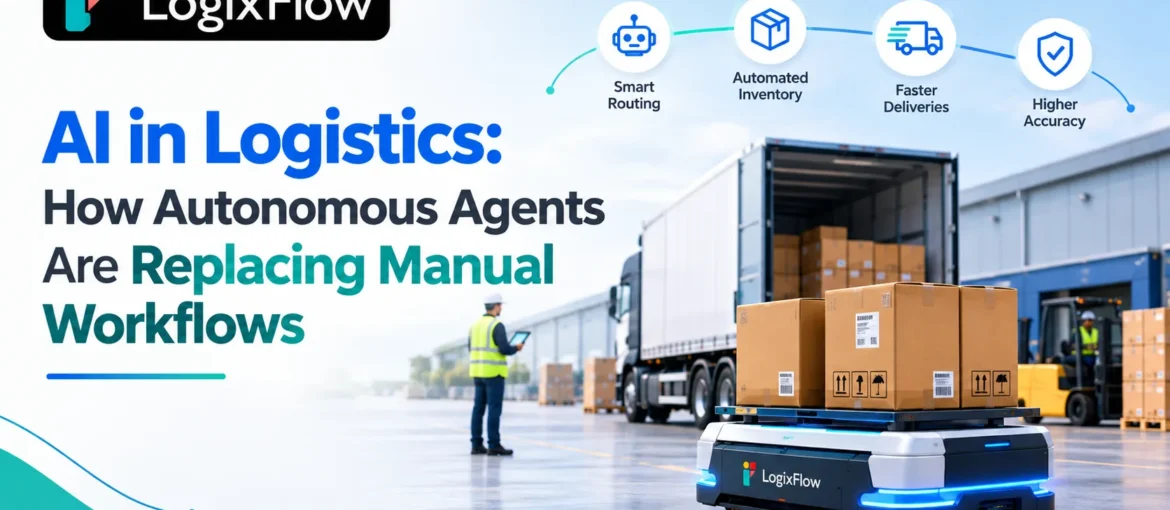
Manual logistics workflows have a well-documented problem: they don’t scale. A coordinator updating shipment statuses across 50 orders at once makes errors. An operations team manually routing 200 daily deliveries misses optimisation that software catches immediately. A warehouse team relying on spreadsheets to manage inventory creates delays that compound downstream. AI in logistics addresses this not by automating individual tasks in isolation, but by replacing the coordination layer that humans have always been the bottleneck for.
The shift happening in 2026 isn’t just software getting faster — it’s AI agents taking ownership of entire workflows, from order receipt to last-mile confirmation, without a human touch point at every step. LogixFlow, part of the LogixGrid platform, is built on this premise: intelligent workflow automation that removes manual dependencies from logistics operations at scale. This guide covers how AI in logistics works, what AI agents actually do, and where this is heading.
How Is AI Used in Logistics?
AI in logistics covers several distinct application areas, each solving a different operational problem:
Route optimisation — algorithms process delivery locations, vehicle capacities, time windows, driver hours, and real-time traffic to generate optimal routes. What a human dispatcher might spend 45 minutes on, a route optimisation engine resolves in seconds — and updates dynamically when conditions change.
Demand forecasting — machine learning models analyse historical order patterns, seasonal variation, and external signals to predict what stock will be needed where and when. Better forecasts reduce both stockouts and excess inventory holding costs.
Shipment tracking and exception management — AI systems monitor shipment progress against expected timelines and surface exceptions before they become customer complaints. The system flags a delayed consignment and triggers a response workflow without a human noticing it first.
Warehouse automation — AI-driven picking systems, slotting algorithms, and autonomous mobile robots work within warehouse management systems to increase throughput and reduce error rates. Warehouse automation is advancing from tools that assist humans to systems that operate with minimal human oversight.
Document processing — invoices, bills of lading, customs documents, and delivery confirmations all contain structured data that AI can extract, validate, and process faster and more accurately than manual entry.
What Are AI Agents in Logistics?
What are AI agents? AI agents are software programs that observe the environment, make decisions, and take action towards a goal, without human guidance or intervention. This is different from a typical logistics software system, where the human observes the problem and kicks off a process; in an AI-enabled system, the agent watches the environment, detects the problem independently, and takes action directly in the set of operations it’s authorized to perform.
For example, an AI agent in logistics could: Monitor every in-flight shipment and notify upon delay; autonomously rebook a missed collection; update inventory counts after receipts in a warehouse; auto-generate and email status notifications to customers; highlight a carrier’s recurring failures to meet SLA targets, for escalation.
Notice how there’s nothing here to kick-start the task – the agent detects the condition and acts. The result: tasks that used to be consuming and top-of-mind now run in the background and surface only when a new situation arises that needs human intervention.
AI Agents for Logistics: Four Use Cases
AI agents for logistics deliver the fastest return where work is repetitive, time-sensitive and spread across several systems. These are the four use cases most logistics teams start with.
AI Agents for Dispatch
A dispatch agent assigns jobs to drivers and vehicles by weighing location, capacity, time windows and driver hours. It re-plans when a vehicle is delayed or an urgent order arrives, so dispatchers review exceptions instead of building every plan by hand.
AI Agents for Proof of Delivery
A proof of delivery agent collects signatures, photos and timestamps from the driver app, checks them against the order, and files them automatically. Missing or mismatched proofs are flagged at once, which shortens invoicing cycles and reduces delivery disputes.
AI Agents for Last-Mile Delivery
In last-mile delivery, agents sequence stops, send customers accurate ETAs and rebook failed deliveries without manual calls. They watch live traffic and driver progress, and adjust routes so more parcels are delivered on the first attempt.
AI Agents for Shipment Visibility
A visibility agent monitors every in-flight shipment across carriers and systems, compares progress with the promised timeline, and alerts the team and the customer before a delay becomes a complaint. Customers get proactive updates without anyone chasing carriers for status.
Read more:CRM Software Explained: Benefits, Features & How It Works
How AI Agents Are Replacing Manual Workflows
Order processing. Traditional: an operator receives an order, checks stock availability, allocates inventory, creates a pick task, and books a carrier. With AI workflow automation in logistics, each of these steps triggers the next automatically based on defined rules and AI decision-making. The operator sees completed orders rather than managing each step.
Carrier selection. Manual carrier selection relies on the coordinator’s knowledge of rates, capacity, and performance. An AI agent evaluates available carriers against current rates, delivery time commitments, historical performance, and cargo requirements — selecting the optimal option in milliseconds.
Exception handling. When a shipment is delayed, the traditional workflow is: delay noticed → coordinator informed → customer notified → alternative arranged. AI logistics automation compresses this: the delay is detected in real time, the customer notification is generated automatically, and an alternative carrier or route is evaluated and presented — or executed within defined parameters.
Invoice reconciliation. Matching carrier invoices to shipment records is manual, repetitive, and error-prone at scale. AI agents cross-reference invoice data against agreed rates and shipment details, flag discrepancies automatically, and queue only genuine disputes for human review.
Benefits of AI in Logistics
Operational speed. The most immediate benefit of AI in logistics is time. Decisions that took hours take seconds. Customer notifications that required coordinator action happen automatically. The entire operation moves faster without proportionally more staff.
Cost reduction. Route optimisation reduces fuel cost. Better demand forecasting reduces inventory holding. Exception management reduces penalty charges from missed SLAs. Collectively, the benefits of AI in logistics compound across every operational cost line.
Error reduction. Human fatigue, distraction, and knowledge gaps create errors in data entry, carrier selection, and routing. AI agents working within defined parameters make consistent decisions without the variation that manual processes introduce.
Scalability. A 10-person operations team managing 500 orders daily hits a ceiling. AI in logistics 2026 is enabling the same team to manage 5,000 orders with better visibility and fewer errors — because the manual coordination layer scales automatically.
Customer visibility. Real-time tracking, automated notifications, and proactive exception communication are all downstream effects of AI logistics automation. Customers experience better service without the logistics business adding headcount.
AI in Supply Chain Management
AI for supply chain management extends beyond the logistics operation into the broader supply chain — procurement, demand planning, supplier management, and inventory optimisation.
AI in supply chain applications include: predicting supplier delays based on historical and external signals, optimising safety stock levels by SKU and location, identifying alternative sourcing options when primary suppliers face disruption, and modelling the financial impact of different inventory strategies.
The integration of AI in transportation, warehousing, and broader supply chain planning creates a connected intelligence layer that previously didn’t exist. Individual systems generated data; AI connects and interprets it across the supply chain.
Supply chain automation at this level changes the role of supply chain managers from data processors to decision reviewers — reviewing what the system has recommended or executed rather than generating every recommendation manually.
AI in Logistics: Challenges and Considerations
Data quality. AI systems are only as good as the data they’re trained on and operate with. Incomplete shipment records, inconsistent carrier data, and unreliable inventory counts create AI outputs that reflect those problems. The first step for any business implementing AI in logistics is cleaning and standardising its data.
Integration complexity. AI tools need to connect with existing TMS, WMS, ERP, and carrier systems. Integration work is real and takes time. Platforms like LogixFlow are built with standard integrations, but each implementation has unique configuration requirements.
Change management. Operations teams whose roles have been built around manual workflows need reskilling and clear communication about what AI handles and what remains with them. The resistance to AI in logistics is rarely technical — it’s organisational.
Explainability. When an AI agent makes a carrier selection or routing decision, the team needs to understand why. Black-box decisions undermine trust and make it difficult to identify when the system is performing incorrectly.
The Future of AI in Logistics
The future of AI in logistics is autonomous orchestration — AI agents coordinating with each other across the full supply chain without waiting for human instruction at each handoff.
In 2026, leading logistics operations are already using AI agents for specific workflows. Within five years, the expectation is that the majority of routine logistics decisions — routing, carrier selection, exception management, inventory replenishment — will be AI-executed, with humans setting parameters, reviewing edge cases, and managing strategy.
Logistics automation will reach the point where the competitive differentiator isn’t which company has the most people managing operations, but which company has the most intelligent and well-integrated AI layer managing them.
Conclusion
AI in logistics isn’t a future capability being evaluated in pilot programs — it’s a current operational reality for businesses that have moved beyond manual coordination. The shift from human-managed workflows to AI-executed processes is happening at the workflow level, not just the task level.
For logistics businesses looking to implement AI workflow automation, the starting point is identifying the highest-volume manual processes — the ones where volume, repetition, and error cost are highest. Those are where AI agents deliver the most immediate return.
LogixFlow provides AI-powered logistics workflow automation for 3PLs, freight companies, and supply chain operations — connecting order management, carrier integration, tracking, and exception management in one intelligent platform. Visit logixflow.logixgrid.com to explore how AI in logistics can replace your manual coordination overhead.
FAQs
1. What is AI in logistics?
AI in logistics uses intelligent systems to automate tasks such as route optimisation, shipment tracking, demand forecasting, and exception management.
2. What are AI agents in logistics?
AI agents in logistics monitor operations, identify issues, make decisions, and take authorised actions without requiring constant human intervention.
3. What are the benefits of AI in logistics?
Key benefits include faster operations, lower costs, fewer errors, improved scalability, and better customer visibility.
4. How does AI improve supply chain management?
AI for supply chain management helps with demand planning, inventory optimisation, supplier monitoring, and identifying alternative sourcing options.
5. What is the future of AI in logistics?
The future of AI in logistics is autonomous orchestration, where AI agents coordinate routing, carrier selection, inventory, and exceptions with limited human intervention.




Leave A Comment